

Curator: Noorjehan Bilgrami
By Rumana Husain and Mukhtar Husain
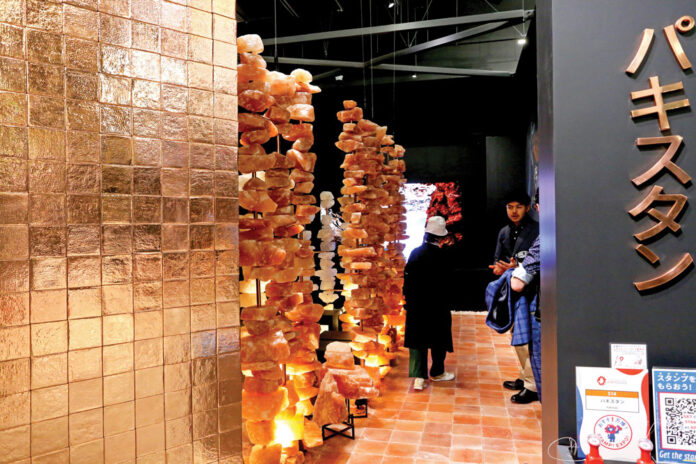
At the heart of Expo 2025 Osaka—titled, Designing Future Societies for Our Lives—the Pakistan Pavilion stands not just as a physical edifice, but as a quietly pulsating organism, breathing with ancient mineral life. Eschewing the fanfare of glass façades and techno-futurist motifs, the Pavilion showcases the pink salt of Pakistan’s 800 million years old Salt Range. Here, architecture becomes both relic and remedy—a poetic gesture that captures, with an admirable economy of means, the curatorial theme of “The Universe in a Grain of Salt.”
Unlike many national pavilions which often read as declarations of modernity or spectacle-driven branding exercises, the Pakistan Pavilion offers a rare counterpoint: a minimalist sanctum that appeals to the senses, slows down time, and beckons visitors to contemplate the elemental. Rock salt, in this context, becomes more than a material—it is a metaphor, a symbol of endurance, and a vessel of collective memory. It is the Pavilion’s medium, message, and muse.


The Origins and Evolution of World Expos
The World Expo concept traces its origins to the Great Exhibition in 1851, held at London’s Crystal Palace. Conceived by Prince Albert and organised by Henry Cole, this was the first global stage celebrating industry, culture, and technology—setting the precedent for international gatherings showcasing national achievements and fostering global understanding.
Historical Milestones
- 1851 London: Pioneered global exhibitions.
- 1893 Chicago: Iconic event introducing electric illumination.
- 1967 Montreal: Celebrated modernity in Expo ‘67.
- 2010 Shanghai & 2015 Milan: Merged tradition with futuristic visions.
- 2020 Dubai: for the “Connecting Minds, Creating the Future” theme, the Pakistan Pavilion highlighted, cross-sector themes centred on sustainability and innovation.
- 2023 Doha: for the “Green Desert, Better Environment” theme, the Pakistan Pavilion centred on sustainable agriculture and cultural heritage.


Pakistan in Past Expos
The Pakistan Pavilion at the Expo 2017, Astana, Kazakhstan featured a mosaic façade titled “Resplendent, Magnificent Pakistan,” celebrating diverse landscapes from K2 to the Thar Desert. Artisans performed live crafts, while exhibits highlighted wind energy innovations.
In 2018, Pakistan participated at the Lyon world cultural festival in France, showing documentaries, crafts, and cuisine as part of a soft-diplomacy initiative.
At the Dubai Expo 2020, curated by Noorjehan Bilgrami, the Pakistan Pavilion embraced the theme “Pakistan: The Hidden Treasure,” portraying 7,000 years of history and promising future potential. However, there was a radical departure from the other versions. Whereas the dynamic and eye-catching exterior façade was designed by the noted Pakistani artist Rashid Rana featuring 24,000 individual prism-like modules, symbolising Pakistan’s diversity, the interior featured immersive zones like the Sheesh Mahal corridor—celebrating mirror-work and spiritual heritage—alongside displays of natural wonders, cultural coexistence, and artisanal crafts.


This won the Silver Award for Interior Design from among 192 entries. It was a milestone for Pakistan.
Japan has been a source of inspiration for Noorjehan Bilgrami and holds a cherished place in her life. For the Pakistan Pavilion, Osaka, also curated by her, the vision threads art, architecture, science, and sustainability into a seamless narrative—a reflection of her longstanding commitment to material heritage and contemporary craft. She and her small curatorial team—architect Fatima Ausat, sculptor Fahim Rao, architect Irfan Naqi—have created this Pavilion as a sensory encounter.
The message of the Pavilion is clear: Salt is not just a culinary or economic resource; it is a custodian of culture, health, and ecological wisdom. The educational exhibits, including interactive salt table and mineral displays, make this message accessible. Scientific data and sensory play are beautifully integrated, offering visitors layered ways of understanding Pakistan’s geological and wellness traditions.
Moreover, the Pavilion’s post-Expo plans are well-defined. All salt used in the construction will be repurposed, ensuring that nothing is wasted.


The architecture of the Pavilion is conceptualised around salt’s innate properties—its translucency, crystalline texture, fragility, and its ancient presence. The Pavilion’s area is 50 sq metres. It is situated at the back of a large hall under one common roof with 25 other countries. A commercial space of 17 sq metres is situated diagonally in front of the Pavilion.
The floors, walls, and installation features are composed entirely of Pink Himalayan Salt. To the right, a long charcoal wall stretches out, gradually giving way to sweeping views of the majestic landscape and ancient terrain of the Potohar mountain range, home of the historic salt mines. The wall opens with a specially commissioned Urdu poem by Zehra Nigah, presented alongside its English and Japanese translations. The charcoal wall provides a striking backdrop for hand-painted imagery in the Miniature tradition by Farooq Mustafa Maeda, a Pakistani artist who has lived in Japan for the past 24 years. He has meticulously rendered each detail directly onto the wall with sensitivity and skill.


Chronologically arranged printed panels trace the origin of salt, beginning with its formation from an ancient sea over 800 million years ago. The wall highlights the remarkable fossil record, spanning nearly 20 million years. This salt has been a silent witness to human history, its rituals, conquests, cultural exchanges, and the steady movement of people and ideas across time. This is not just a sustainable or aesthetic choice—it is a philosophical one. The tactile and olfactory experience of walking on and among salt-laden surfaces, breathing in the mineral-rich air, and witnessing the soft interplay of light refracted through translucent salt blocks, creates a sense of being “inside” the material rather than merely observing it.
The pink hue of the salt carries with it the trace of deep geological time. It is the iron content—mineral remnants of prehistoric oceans—that imbues the salt with its gentle blush. In a sense, to walk through the Pavilion is to walk through time, through sediment and story, through a medium that remembers the primordial. This is architecture not as statement but as invitation— to introspect, to feel, to remember. Such tactility, in an increasingly digital world, is radical.
From a strictly architectural standpoint, the Pavilion is both a meditation on materiality and a study in atmospheric design. The sculptural interventions, respect the salt’s structural delicacy, resulting in forms that are robust. There is an organic softness in how the structures are composed—walls seem to have been grown, not built.


Light plays a key role in animating the space, and sensitive lighting design avoids theatricality. Instead, it employs warm, low-intensity illumination that seeps through salt walls and bounces gently off mineral surfaces, creating a subdued, other-worldly glow. In some sections, the light is diffused to the extent that it feels like being inside a living crystal. This use of light not only highlights the salt’s translucency but also serves a thermos-regulatory function, contributing to the Pavilion’s commitment to energy efficiency. We remember this light very well from our visit to the Khewra Mines many years ago.
‘The Healing Garden’ chamber operates not merely as a room, but as a ritual. The air is subtly infused with salt vapours; the textures underfoot are granular and cool; the walls glisten faintly. Visitors are encouraged to sit, reflect, and allow the mineral air to calm both breath and mind. It is an almost monastic experience, where architecture functions as therapy. Unlike the clinical aesthetics of modern health spaces, here the cure is gentle, elemental, and wrapped in beauty. This spatial gesture is deeply political as well. It reclaims traditional, natural methods of healing in an age of pharmaceutical excess. It reframes wellness not as a luxury commodity, but as a birthright embedded in the land itself. By spotlighting halotherapy, the Pavilion subtly critiques the global health- industrial complex and posits a model of preventive, accessible, and low-impact care.
A GRAIN OF SALT, A WORLD OF MEANING
Ultimately, what makes the Pakistan Pavilion unforgettable is its ability to do so much with so little. It offers a profound meditation, focusing on the smallest things—grains of salt, breaths of air, and shafts of light—and connects them to the largest questions of our time: How shall we live? What shall we value? Can healing be simple, beautiful, and shared?
The Pakistan Pavilion is deeply rooted in the South Asian context. It draws from Sufi metaphors, healing rituals, and vernacular knowledge systems. In doing so, it reclaims the narrative around natural materials and positions Pakistan not as a peripheral participant, but as a thought leader in sustainable and soulful design.
This is an architecture of humility but also of immense power. It reminds us that materials carry memory, that healing can be sensory, and that even the most modest mineral can become a symbol of resilience, renewal, and radical care. In a global showcase saturated with spectacle, the Pakistan Pavilion is a quiet revolution—one that speaks not through megawatts or megastructures, but through mineral logic, ancient wisdom, and the architecture of the essential.
World Expos remain pivotal platforms for nations to weave narratives that intertwine history, innovation, and global collaboration. Pakistan’s active presence—through emblematic pavilions at Dubai Expo 2020 and Osaka Expo 2025 —reflect its potential and desire to be recognised as a centre for culture, tourism, and sustainable development.
As the world advances, Pakistan’s commitment to thoughtful, impactful participation in future Expos could catalyse deeper collaborations, enhance its global narrative, and inspire renewed pride in its rich legacy and promising future.
About the Authors: Rumana Husain is an artist, writer, and art critic. Mukhtar Husain is an architect and architectural critic. Both are based in Karachi, Pakistan


NOORJEHAN BILGRAMI, PRINCIPAL CURATOR
Noorjehan Bilgrami the Principal Curator of the Pakistan Pavilion at Expo 2025 in Osaka, is a distinguished visual artist, curator, researcher, author, and educationist. She was also behind the award-winning Pavilion at Expo 2020 Dubai, which ranked second among 92 countries.
In 2023, she received the Tamgha-e-Imtiaz for her contributions to arts and crafts. A founder of the Indus Valley School of Art and Architecture (IVS), she served as its first Executive Director and remains on its Board of Governors. She also serves on the board of the Pakistan Fashion Institute.
She established KOEL in 1978, reviving hand-block printing, weaving, and natural dyes. Since 1990, KOEL Gallery has hosted over 300 exhibitions, supporting emerging artists. Her art installations and residencies span globally—from Sydney and Hawaii to Tokyo and Qatar—while her exhibition Tana Bana travelled across the US and Japan.
She is the author of several books, including Sindh jo Ajrak and Clay, Cloth, Wood, Metal, and Stone. Her contemplative art practice explores deeply personal yet universal themes and has been showcased in solo and group exhibitions in Pakistan, USA, Australia, Korea, Sri Lanka, South Africa and India.


